
Real Birth Choices Explained: Home Birth, Birth Centre or Labour Ward?
Home birth, birth centre or labour ward? If you're pregnant and starting to think about where you'd like to give birth, you may be wondering which option is right for you and your baby.
Understanding your options can help you feel more informed, confident and prepared when talking to your midwife and maternity team.
In this blog, I'll walk you through the differences between home birth, birth centre and labour ward birth, including the benefits, things to consider and how a doula can support you whatever you decide.
Where can you give birth?
In the UK, many women can choose from a range of birth settings, depending on their health, pregnancy and the maternity services available locally.
Your midwife can talk you through the options available to you and whether there are any particular recommendations based on your individual circumstances.
When you're thinking about where you'd like to give birth, it can be helpful to consider:
Where you feel most comfortable and relaxed
How you feel about a hospital environment
Which pain relief options are important to you
Any medical considerations during your pregnancy
How you'd like your partner or birth support to be involved
What helps you feel safe and supported
And remember: you don't have to make a final decision straight away. Your preferences can change as your pregnancy progresses.
Home Birth: Giving Birth in Familiar Surroundings
A home birth means giving birth in your own home, supported by NHS or private midwives.
For many families, the biggest attraction is simply being somewhere familiar. You can move around your own space, have your own food and drinks nearby, and settle into those precious first hours with your baby without needing to travel home afterwards.
What are the benefits of a home birth?
Potential benefits include:
Staying in a familiar and comfortable environment
Greater privacy and control over your surroundings
Freedom to move around as you wish
Easy access to your own food, drinks and comforts
Avoiding travelling while you're in labour
Being able to remain at home after your baby is born
Some families also love the idea of older siblings being able to remain in their familiar surroundings, where appropriate.
Is home birth safe?
For women with healthy, straightforward pregnancies, planned home birth is recognised as an option by the NHS and NICE. As hospital birth is often seen as the default option, many people assume that giving birth at home must carry greater risks. However, the evidence tells a more balanced story.
The UK Birthplace Study, which looked at more than 64,000 births, found that for women having their second or subsequent baby, planned home birth was as safe for babies as planned birth in hospital settings.
The study also found lower rates of medical intervention among women planning home births.
That included lower rates of:
Caesarean birth
Forceps birth
Ventouse birth
Episiotomy
Labour augmentation with synthetic hormones
Continuous electronic fetal monitoring
Of course, this doesn't mean that medical intervention should be avoided when it's needed. Interventions can be important and sometimes life-saving.
It's simply useful to understand that, for women with low-risk pregnancies, the birth setting can influence the likelihood of intervention.
What happens if you need medical support?
Choosing a home birth doesn't mean being without professional care.
Midwives attending home births bring equipment to support normal labour as well as respond to emergency situations. This can include monitoring equipment, oxygen, emergency medication, equipment for managing heavy bleeding and equipment to support newborn resuscitation if required.
Sometimes a transfer to hospital is recommended if labour isn't progressing as expected, additional monitoring is needed or pain relief isn't available at home.
Knowing that transfer is a possibility doesn't have to make you feel worried. For many parents, understanding the plan helps them feel prepared and reassured.
Birth Centres: A Gentle Middle Ground
Birth centres, sometimes called midwife-led units, offer a more homely environment while providing professional maternity care.
They are designed to support physiological labour and birth, and many women appreciate the balance between a calm environment and access to maternity professionals.
Alongside birth centres
An alongside birth centre is located within, or very close to, a hospital maternity unit.
This means that if additional support is needed, access to obstetricians, anaesthetists and neonatal teams is nearby.
For some parents, this offers a lovely balance: a calmer birth environment while knowing that specialist support is close by if needed.
Freestanding birth centres
A freestanding birth centre is separate from a hospital.
These centres are designed specifically for low-risk births and often offer a peaceful, relaxed environment. If additional medical support becomes necessary, transfer to hospital would be arranged.
What can a birth centre offer?
Depending on your local unit, you may find:
Comfortable, homely birth rooms
Birth pools
Softer lighting and furnishings
Freedom to move around during labour
Support for physiological birth
Pain relief options vary between birth centres, so it's worth finding out what's available at your local unit. For example, epidurals aren't generally available within a midwife-led birth centre.
Your midwife can help you understand what your local birth centre offers and whether it's appropriate for you.
Labour Ward: Hospital-Based Maternity Care
A hospital labour ward provides access to a wider range of medical and specialist services.
Midwives, obstetricians, anaesthetists and other healthcare professionals work together to support women throughout labour and birth.
Why might you choose a labour ward?
A labour ward can offer immediate access to:
Obstetric doctors
Epidural pain relief
Continuous foetal monitoring when needed
Operating theatres
Emergency care
Specialist neonatal support
For women with higher-risk pregnancies, or those who need closer monitoring or additional medical support, a labour ward may be the most appropriate setting.
What is a labour ward like?
Every maternity unit is different, but labour wards are generally more clinical than home or birth-centre environments.
You'll usually see medical equipment and monitoring devices, although many maternity units work hard to create welcoming, family-centred spaces and support women to make choices about movement, positions and comfort wherever possible.
Does Where You Give Birth Affect Your Chances of Intervention?
Research from the UK Birthplace Study found that, among women with uncomplicated pregnancies, those planning birth at home or in a midwife-led unit experienced fewer medical interventions than those planning birth in an obstetric unit.
This included interventions such as caesarean birth, forceps, ventouse, episiotomy, labour augmentation and continuous electronic foetal monitoring.
The important thing to remember is that this doesn't mean a hospital birth causes interventions, or that interventions are necessarily negative.
Hospitals have greater access to monitoring, specialist staff and medical procedures. Sometimes those things are exactly what you or your baby need.
Understanding the differences simply gives you more information to consider when making your own decision.
How Does Pain Relief Differ Between Birth Settings?
Pain relief is an important consideration for many women when choosing where to give birth.
Home birth
Depending on local services, options may include:
Breathing and relaxation techniques
Water immersion
TENS
Gas and air (Entonox)
Movement and positioning
Birth centre
Birth centres commonly offer:
Birth pools
Gas and air
Movement and positioning
Relaxation techniques
Labour ward
Hospital labour wards generally offer the widest range of pain relief options, including:
Gas and air
Opioid pain relief
Epidurals
Additional medical pain management where required
So, Which Birth Setting Is Safest?
This is often where conversations about birth place become complicated.
For women with uncomplicated pregnancies, home, birth centre and labour ward settings can all be appropriate places to give birth when supported by suitable maternity care.
The important differences aren't simply about one setting being “safe” and another being “unsafe”. They also include the level of medical support immediately available and the likelihood of intervention.
Your own health, pregnancy and individual circumstances matter too.
This is why talking openly with your midwife is so important. They can help you understand how the options apply to you, rather than simply relying on general information.
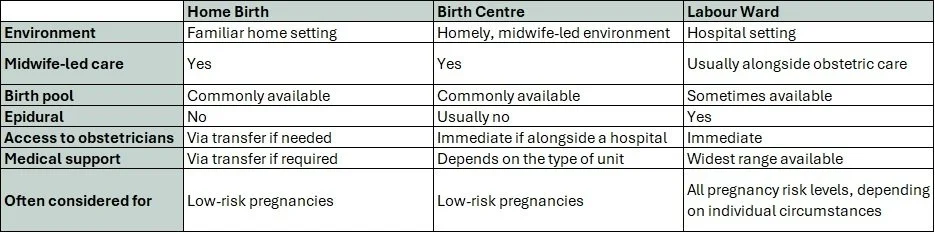
Home Birth, Birth Centre or Labour Ward: At a Glance
Make it stand out
Whatever it is, the way you tell your story online can make all the difference.
Always check with your local maternity service, as facilities and available options vary between units.
How Can a Doula Support Your Birth Choices?
You don't need to have everything figured out before you have your baby.
As a doula, my role is to help you explore your options, understand the information available to you and feel confident asking questions of your maternity team.
I don't replace your midwife or medical team. Instead, I offer emotional, practical and informational support throughout pregnancy, birth and the early days of parenthood.
This might include:
Talking through your birth preferences
Helping you think about the questions you'd like to ask your maternity team
Exploring comfort and relaxation techniques
Helping your partner feel confident and involved
Offering continuous emotional support during labour
Helping you prepare for different possibilities
Whether you're planning a home birth, birth centre birth or labour ward birth, my aim is the same: to help you feel informed, supported and confident in your choices.
There Isn't One “Right” Way to Give Birth
Perhaps the most important thing to remember is that there is no one-size-fits-all answer.
For one woman, being at home in familiar surroundings may feel exactly right.
For another, a birth centre may offer the balance she is looking for.
And for someone else, having immediate access to the full range of hospital services may bring the greatest sense of reassurance.
Your birth setting is just one part of your birth story.
Take time to explore your options. Ask questions. Visit your local maternity units if you can. Talk honestly with your midwife about your preferences and any concerns you have.
And remember that your choices can change. You don't have to have every decision made from the moment you see those two lines on a pregnancy test.
What matters is that you have the information and support you need to make decisions that feel right for you, your baby and your family.
Looking for doula support in Berkshire, Surrey or the surrounding areas?
If you're preparing for birth and would love someone alongside you to help you explore your choices, prepare for different possibilities and feel more confident about the journey ahead, I'd love to support you. Click HERE for a free 30 minute consultation
Together, we can create a birth preparation plan that reflects your wishes, your questions and your individual needs — helping you feel informed, supported and cared for every step of the way.